Cash Envelope System: Honest Pros, Cons, and Who It Really Suits
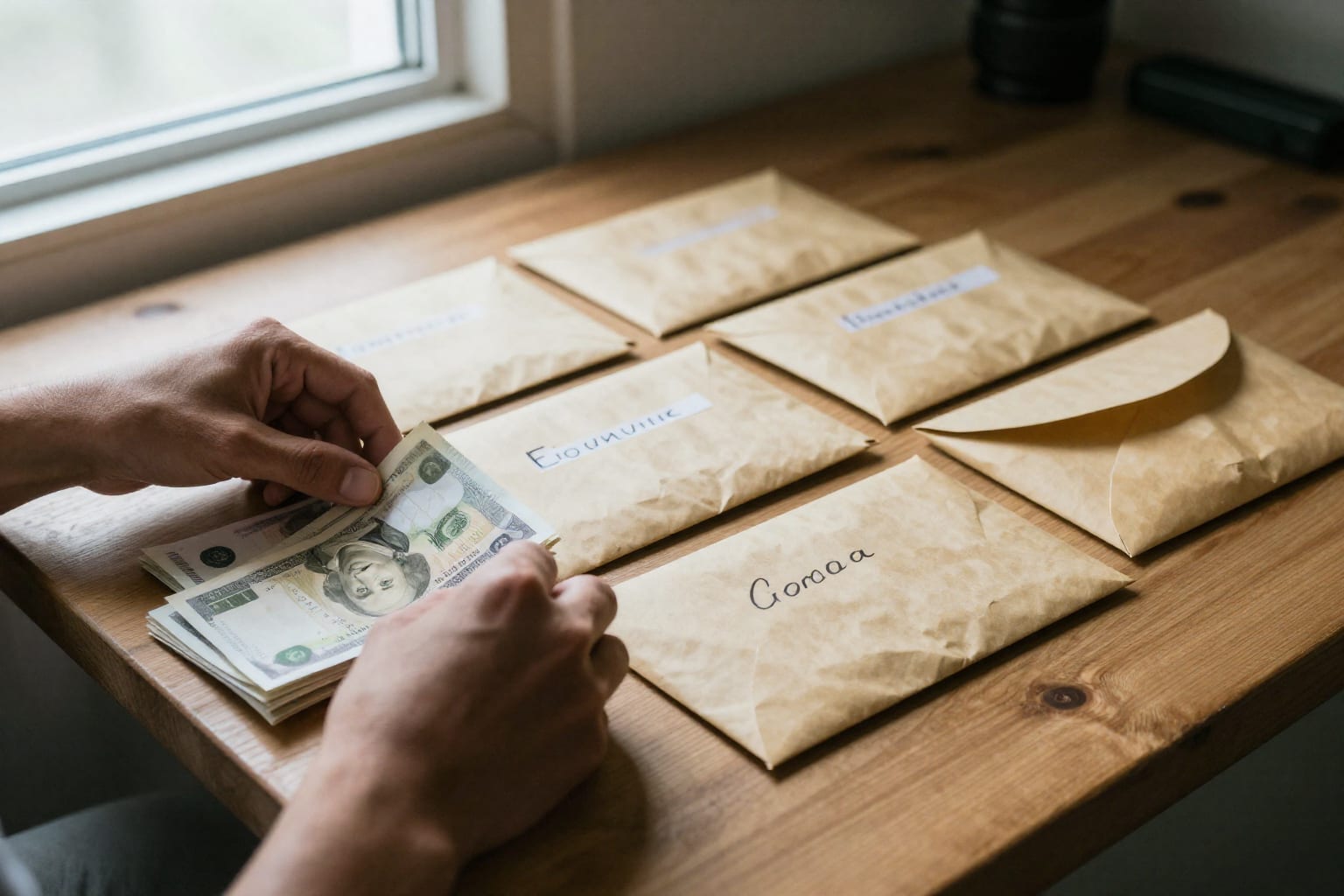
I pulled $340 in cash out of an ATM on a Sunday afternoon and divided it into six labeled envelopes at my kitchen table. Groceries. Dining out. Gas. Fun money. Clothing. Personal care. It felt a little absurd at first — I'm a person who pays for everything on a phone tap. But three months later, I had cut my grocery overspend by roughly $80 a month without really trying harder. The cash envelope system did something no spreadsheet ever managed: it made the limit feel real.
What the Cash Envelope System Actually Is
The cash envelope system is a physical budgeting method. You allocate a fixed amount of cash to specific spending categories at the start of each pay period, seal each amount in a separate labeled envelope, and only spend what's in that envelope for that category. When the envelope is empty, you stop spending in that category until the next period.
That's the whole mechanism. There's no app required, no syncing, no algorithm. The constraint is physical: you can see and feel exactly what's left. The method has roots going back decades and was popularized more recently by financial educators like Dave Ramsey, though the core idea predates any specific brand of personal finance advice.
What makes it distinct from a digital budget is the friction. Every purchase requires you to open an envelope, count out bills, and watch the pile shrink. That friction is both the system's greatest strength and its most common point of failure.
The Real Pros: Why People Swear by This Method
The biggest advantage isn't willpower — it's architecture. A digital budget tells you how much you should have spent. A cash envelope tells you how much you can spend, right now, in a form you cannot fudge with a tap. That distinction is enormous for anyone who has ever reviewed a monthly statement and thought, "where did all of that go?"
Overspending becomes structurally harder. You physically cannot spend $60 at a restaurant if there's only $35 left in the dining envelope. With a card, that same purchase goes through without a second's pause. With cash, you either negotiate with yourself at the table or you leave with less food. The decision happens before the transaction, not three weeks later during a budget review.
There's also a documented psychological effect sometimes called the "pain of paying" — paying with physical money triggers a stronger emotional response than swiping a card. Researchers have observed that cash transactions feel more costly, which tends to make people more deliberate. Whether that effect lasts long-term varies by person, but it's real and it's the engine behind the envelope method's success.
Finally, it works completely offline. No subscription, no app update, no privacy concern. If your financial situation is chaotic and you need a reset that doesn't require technology to function, a stack of envelopes and a pen will do the job.
The Real Cons: Where It Falls Short
Inconvenience is the honest first problem. Most modern life doesn't run on cash. Online orders, subscription services, utility auto-pays, transit apps — none of these accept a $20 bill. You'll end up running a parallel system anyway for digital expenses, which adds mental overhead and can undermine the simplicity that makes envelopes appealing.
Carrying cash also introduces security risk. Losing your wallet or having it stolen when it's loaded with your month's discretionary spending is a real setback, not an abstract possibility. Cards have fraud protection; cash doesn't. Some people mitigate this by keeping the envelopes at home and carrying only a small daily portion, but that adds another layer of logistics.
Then there's the rewards question. If you'd normally earn 2% cashback or travel points on grocery spending, switching to cash has a real, calculable cost. On $400 a month in grocery spend, that's roughly $96 a year in foregone cashback. That's not nothing. For people who pay their cards off in full each month, the envelope system may cost more than it saves in discipline.
Change management is another friction point most guides skip. Making exact-change purchases slows down checkout lines. Getting correct change back and mentally re-sorting it into envelopes is a small annoyance that compounds across hundreds of transactions. Several people I know who tried this dropped it not because the budget failed, but because the physical hassle wore them down within six weeks.
My Own Experience Trying It for Three Months
I ran the system from January through March, choosing four categories where my spending felt most out of control: groceries, dining out, personal care products, and what I called "stuff" — the random household items and impulse buys that don't fit anywhere clean in a budget app.
Groceries got $320 per month. That was based on three months of card statements showing I'd been spending between $390 and $430, apparently without noticing. I took out $320 in cash on the first of the month and put it in an envelope marked with a simple label and the date. I kept the envelope in my bag for the first two weeks and at home after that, carrying only what I needed for a specific shopping trip.
The first week was uncomfortable. I made a list before every store visit — something I'd theoretically done before but rarely followed. On one trip, I reached the register at $341 and had to put back two items. That moment was embarrassing and instructive. I stood there reassessing a $6 bottle of olive oil and a $14 specialty cheese. I put back the cheese. I've thought about that cheese more than I should have, and I've also stuck to my list more consistently than I did in the two years before this experiment.
By month three, I was finishing grocery months with $20 to $40 remaining. Not because I was eating less or buying worse food — I'd just stopped the low-grade drift of throwing things in the cart because they looked interesting. The dining-out envelope was harder. I set it at $120 and blew it every month. But at least I knew I was blowing it, and by month three I'd voluntarily cut it to $90 and actually held the line.
"Stuff" was the unexpected win. I'd been spending somewhere between $60 and $150 on miscellaneous items monthly. With a $70 envelope, I stopped buying things I didn't need simply because I could see there was only $23 left and the month wasn't over. The physical visibility of a shrinking pile of bills is a more effective deterrent than any notification from a budgeting app, at least for me.
Who the Cash Envelope System Actually Works For
This method suits people who overspend consistently in variable, discretionary categories and who find digital tracking abstract or easy to ignore. If you've tried budgeting apps, set spending targets, and still blow past them every month, the friction of physical cash may be the missing ingredient — not better data, but a harder constraint.
It also works well for people resetting after a period of financial disorder. If you're climbing out of high-interest debt and need a system that creates no new digital accounts, no subscriptions, and no complexity, envelopes are as low-barrier as budgeting gets. You need cash, some envelopes, and a pen.
Households that spend heavily in grocery and dining categories — two areas where card spending is easiest to let drift — often see the clearest results. These are the categories where the tactile limit lands with most force. Paying $178 in cash for a week of groceries feels different from the same transaction on a card.
I'd also suggest this for people who are concrete thinkers rather than abstract ones. If spreadsheets and apps feel like maintaining a scoreboard you can argue with, but a physical pile of money feels like a real object you're responsible for, the envelope system aligns with how your brain processes information.
Who Should Skip It (and What to Try Instead)
If most of your discretionary spending happens online — food delivery apps, streaming add-ons, online retail — cash envelopes will cover maybe 30% of your variable spending. The system will feel incomplete and you'll still need a digital method for the rest. In that case, a zero-based budgeting method applied digitally in an app like YNAB will give you the same category-limit discipline without the physical logistics.
People who already pay their credit cards in full each month and earn meaningful rewards should do the math carefully. The psychological benefit of cash needs to outweigh the cashback you'd forfeit. For many disciplined cardholders, it won't.
Couples where one partner handles cash and the other doesn't can run into friction here too. If one person is tracking envelopes and the other is tapping a card for the same categories, the system breaks. Both people have to genuinely commit, or neither should bother.
For these situations, consider budgeting apps designed for beginners that replicate the envelope logic digitally. Goodbudget and YNAB both use category-envelope frameworks without requiring physical cash. They work better for shared budgets and online-heavy spending patterns. This is general information about budgeting methods, not personalized financial advice — your specific situation may call for a different approach entirely.
Practical Tips If You Want to Give It a Try
Start with three categories, not seven. Pick the areas where your spending feels most unpredictable — for most people that's groceries, dining out, and one personal category. Running a tight system across three envelopes is far more sustainable than an ambitious eight-envelope setup that collapses by week two.
- Base your starting amounts on actual past spending, not aspirational targets. Check three months of statements and use the average. Then cut 10-15% for a realistic but achievable target.
- Keep envelopes at home and carry only what you need for a specific trip. This reduces loss risk and keeps the full monthly amount safe.
- Handle fixed costs — rent, utilities, subscriptions — digitally as usual. Envelopes work for variable discretionary spending, not autopay bills.
- If you end a month with cash remaining, decide in advance whether it rolls over or gets swept to savings. Both choices are valid; just make the rule before the month ends.
A hybrid approach often works best long-term: physical envelopes for your two or three most problematic categories, and a simple 50/30/20 framework for the bigger picture. The envelope system doesn't have to be all-or-nothing to be useful. If grocery cash alone saves you $60 a month, that's $720 a year with minimal effort. Worth bookmarking this before your next paycheck hits.
The Bottom Line
The cash envelope system is a blunt tool — and sometimes that's exactly what a situation calls for. It won't suit everyone, and it has real costs in convenience, rewards, and physical security that are worth weighing honestly. But for people who find digital budgets too easy to rationalize past, the physical reality of a shrinking envelope is harder to argue with. Try it for one month in one category. The data you get from that single experiment will tell you more about whether it fits your habits than any general guide, including this one.